Launch of a new research report on women’s access to justice in Afghanistan at the University of Toronto
5 May 2026
The Women and Children Research and Advocacy Network (WCRAN), in collaboration with the University of Toronto’s Centre for European and Eurasian Studies at the Munk School of Global Affairs & Public Policy, launched its latest research report titled “Women’s Access to Justice in Afghanistan” during an international event conducted at the Campbell Conference Facility, Munk School of Global Affairs & Public Policy, 1 Devonshire Place, Toronto, ON. The gathe
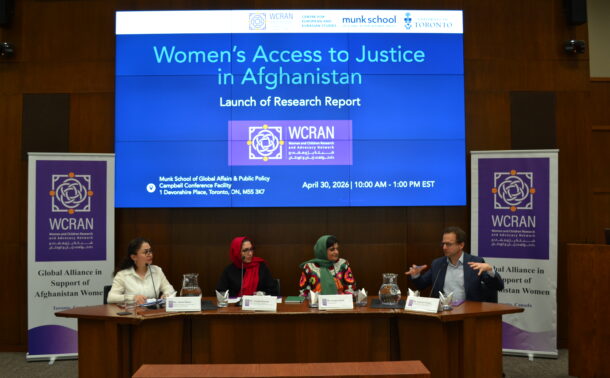
ring brought together legal experts, civil society activists, academics, diplomats, and journalists to raise awareness about the situation of women in Afghanistan and draw global attention to the structural barriers to their access to justice.
The event took place against the backdrop of the most severe systemic deprivation and institutionalized gender apartheid faced by Afghanistan women, which has drastically restricted their access to justice. The event aimed to present the fi
ndings of the research report and mobilize legal and political actors to respond to the ongoing humanitarian and human rights crisis.
The research report indicates that Afghanistan’s justice system has undergone a fundamental transformation since the Taliban’s return to power in August 2021, with formal legal institutions replaced by informal mechanisms. Some other key findings include:
- 81% of respondents reported complete or near-complete changes in Afghanistan’s justice system
- 91% said that exclusion of female legal professionals from the judicial sector has severely impacted legal outcomes.
- 95% stated that women no longer pursue legal cases because they lack trust in the justice system under Taliban rule.
- 65% of female respondents reported highly negative experiences when seeking justice through the Taliban courts.
Zarqa Yaftali, founder of WCRAN, stated in her opening remarks that under the Taliban rule, formal justice mech
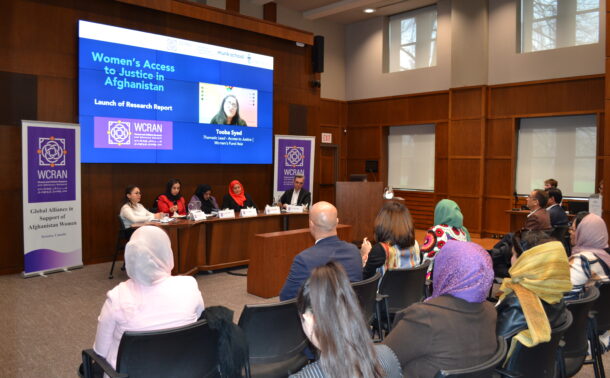
anisms in Afghanistan have been severely weakened and replaced by unjust systems that enhance impunity, especially in cases involving violence against women.
Edward Schatz, Director of the Centre for European and Eurasian Studies, expressed solidarity with Afghanistan women and reaffirmed his commitment to keeping Afghanistan on the agenda in academic and policy circles and to expanding collaboration with Afghanistan institutions.
Presented by Freshta Karimi, the research report findings show that women in Afghanistan have been systematically excluded from the justice system, which has resulted in increased violence, psychological trauma, and widespread despair.
Richard Bennett, UN Special Rapporteur on the Situation of Human Rights in Afghanistan, stressed the importance of international accountability and sustained pressure to improve hum
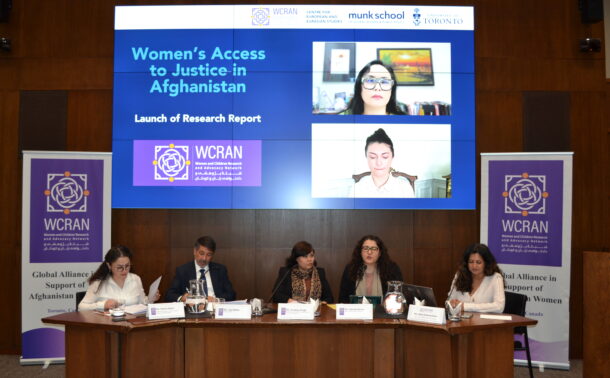
an rights conditions in Afghanistan, especially for women.
Fawzia Kofi, Former Vice President of Afghanistan’s Parliament, noted that the absence of fair trials and the rise in arbitrary detentions have enhanced insecurity and instability in people’s lives.
Ziauddin Yousafzai, Co-Founder of Malala Fund, Women’s Rights and Education Activist, added that the ban on girls’ education is a deliberate strategy to sustain patriarchal control and should be treated as a serious human rights violation.
Hassan Soroosh, Ambassador of Afghanistan to Canada, emphasized that responding to Afghanistan’s crisis requires a coordinated approach that combines research, advocacy, and accountability mechanisms.
The second part of the event was dedicated to two panel discussions examining the report and the broader situation of women in Afghanistan.
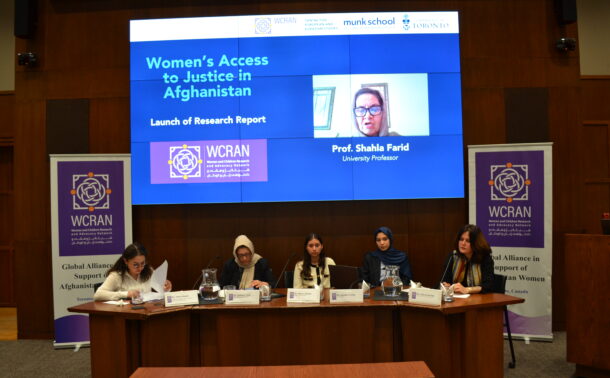 The first panel, moderated by Shoaib Rahim and featuring Najla Raheel, Jamila Afghani, Narges Sadat, Dr Ewelina Ochab, and Tooba Syed, explored how existing legal frameworks affect women’s access to justice and examined increasing challenges to fair trials. Panelists noted that women have been denied access to lawyers and legal representation, while the judicial system has increasingly become a tool of repression.
The second panel, moderated by Akila Radhakrishan, included insights from Ghizaal Haress, Aziz Rafiee, Wazhma Frogh, Lina Rozbih, and Denise Viardo Koh on the role of international legal mechanisms such as global judicial institutions in addressing systematic violations of women’s rights in Afghanistan. Speakers emphasized the urgent need to recognize gender apartheid as an international crime.
The final segment of the event was dedicated to the launch and review of “Being a Woman, Remaining a Woman,” written by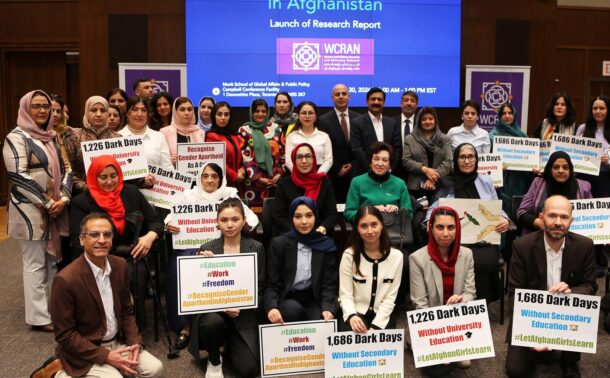 Shahla Farid, a former professor at Kabul University. Moderated by Sahraa Karimi and joined by Salamat Azimi, Marwa Dashti, and Sotoda Forotan, the discussion highlighted the importance of women’s narratives, resilience, and identity under repression. Panelists described the book as a significant contribution to documenting the lived experience of Afghanistan women.
The event concluded with a strong call for sustained and coordinated international action, stronger accountability mechanisms, and enhanced support for civil society organizations, particularly those led by and focused on women. Participants emphasized that without increased international pressure and meaningful structural change, Afghanistan women will continue to face severe barriers in accessing justice.